Movies I own, in no particular order:
The Sixth Sense
Unbreakable
Signs
The Village
The Lady in the Water
Lord of the Rings: Fellowship of the Ring
Lord of the Rings: Return of the King
Narnia: the Lion, the Witch, and the Wardrobe
Princess Mononoke
Hero
Crouching Tiger Hidden Dragon
Moulin Rouge
Final Fantasy VII
Bourne Identity
Bourne Supremacy
Dune (William Hurt version)
Matrix
Matrix Reloaded
Matrix Revolutions
What Dreams May Come
Star Wars II
Star Wars III
The Emperor's New Grove (region 2 :( )
Lawrence of Arabia
About a Boy
Mean Girls
Mr. Nice Guy
V for Vendetta
Edward Scissorhands
Donnie Darko
The Shawshank Redeption (only one I haven' seen yet)
Finding Neverland
The Incredibles
Amelie
Everything is Illuminated
TV shows I own:
Gundam Wing (all seasons)
Arrested Development (all seasons)
X-Men (all seasons)
Heroes (season 1)
Coming soon:
I want to make a graphical representation of the rating system, I'm working on some ideas.
9.25.2007
This blog has not been abandoned
Gee, that was a long break huh? It wasn't meant to be, I hadn't seen many new movies since this amazing summer streak. I have a few reviews I'm working on (Harold and Maude and Amelie and Everything is Illuminated). To be honest, I thought that the rating system would have evolved more than it has. I also had hoped that it would have a slightly bigger following. This tells me that this system isn't usable enough, and needs to be tweaked. Anyone who still does stay tuned, watch for some new stuff that will be put up soon.
8.10.2007
Passion about your passion
I would like to share a link with you all. Have you ever met someone that was majoring in something...say...Studio Recording, but he didn't really have equipment of his own, and he didn't really do much outside of class? It always boggles my mind when I meet someone like that. They take a class, or major in something that they are 'passionate' about, but they complain through the class, and treat their classes as jumping through hoops rather than a learning opportunity. If you aren't really passionate, and want to learn something, why the heck are you in that major, taking those classes. If you are really passionate about something you should be obsessed with it. Take drawing. If you are an illustration major, you are probably totting around a sketch pad with you where ever you go, writing down ideas, practicing drawing all the time, and your roommates are probably tired of the doodles all over the cereal boxes and mail.
In that spirit, I share with you this link: Put your money where your mouth is
In that spirit, I share with you this link: Put your money where your mouth is
Can Read this. Can You?
fi yuo cna raed tihs, yuo hvae a sgtrane mnid too
Cna yuo raed tihs? Olny 55 plepoe out of 100 can.
i cdnuolt blveiee taht I cluod aulaclty uesdnatnrd waht I was rdanieg. The phaonmneal pweor of the hmuan mnid, aoccdrnig to a rscheearch at Cmabrigde Uinervtisy, it dseno't mtaetr in waht oerdr the ltteres in a wrod are, the olny iproamtnt tihng is taht the frsit and lsat ltteer be in the rghit pclae. The rset can be a taotl mses and you can sitll raed it whotuit a pboerlm. Tihs is bcuseae the huamn mnid deos not raed ervey lteter by istlef, but the wrod as a wlohe. Azanmig huh? yaeh and I awlyas tghuhot slpeling was ipmorantt! if you can raed tihs forwrad it .
(Taken from techintheclass.blogspot.com)
fi yuo cna raed tihs, yuo hvae a sgtrane mnid too
Cna yuo raed tihs? Olny 55 plepoe out of 100 can.
i cdnuolt blveiee taht I cluod aulaclty uesdnatnrd waht I was rdanieg. The phaonmneal pweor of the hmuan mnid, aoccdrnig to a rscheearch at Cmabrigde Uinervtisy, it dseno't mtaetr in waht oerdr the ltteres in a wrod are, the olny iproamtnt tihng is taht the frsit and lsat ltteer be in the rghit pclae. The rset can be a taotl mses and you can sitll raed it whotuit a pboerlm. Tihs is bcuseae the huamn mnid deos not raed ervey lteter by istlef, but the wrod as a wlohe. Azanmig huh? yaeh and I awlyas tghuhot slpeling was ipmorantt! if you can raed tihs forwrad it .
(Taken from techintheclass.blogspot.com)
8.06.2007
film: Ratatouille
 Jerman's Rating: 2 steps forward, 1 step back. Content rating of 1 (very light). Appropriate for ages ~6 and up.
 Pixar films are somehow magical, they captivate something that's rare and elusive. Looking at life from a different side, we are told a story that affects the way we see life.
Remmy the rat is passionate about food. I'm passionate about movies. People have their own passions everywhere. Ratatouille is a film about passion, failing and succeeding, responsibility, being critical, and love. These morals will speak to everyone in a different way. When I watched it, I really appreciated the passion and criticism parts. The critic's monologue at the end of the film is masterful. Its important to realize that excellence can come from anywhere. Here, excellence is being provided by a lot of talented people in California with very nice computers.
Speaking about the animation for a bit- this is Pixar's finest yet. At the end of the credits they inserted a graphic stating that the film was made entirely fresh, no motion capture or real photographs etc were used. The visual style was perfect for the feel of the film, and the way things moved was amazing. I don't think we've seen anything this good before.

This film is one of the best movies to come out in this year of very excellent films. I highly recommend it to everyone. Not everyone will love this film, but if you're a Pixar fan-you've already seen it. If you're looking for a good movie, or a date movie, or want to be amazed, then this is the movie for you.
film: Hairspray
 Jerman's Rating: 3 steps forward, 1 step back. Content rating of 2 (light). This film is appropriate for almost all ages, 10 and up.
This film would have gotten a +2, but the moral is taught so thoroughly and well. That moral is civil rights, integration. Slightly less stressed, but still amazing is following your dreams with passion.
I know I step up this rating thing to only talk about morals and things, but I have to make some comments about other things. The music is really amazing. Watching this film is such a positive experience. I was smiling through the whole film, and looking around the entire theater was filled with smiles, everybody that left was so happy. I haven't seen a movie have that affect in a long long time.
The music and dancing makes you want to jump out of your seat and dance in the aisles. This is easily one of my favorite musicals. From the very first song, you fall in love with Tracy, the main character.
The casting was magic. They really could not have picked better actors for each role, each was filled perfectly, I don't know how they did it.
The film handles the morals is teaches very tenderly. The detention hall is full of black students, who pass the time by dancing to a radio, but the black kids dance so well, you just love them, especially because Tracy loves them so much. Love is also handled really well. There are three songs about love- 'I can hear the Bells', 'Timeless to Me', and 'Without love.' It may be a little idealistic and over romantic. I like the way it was handled because this is the way I think it should happen. The way two people fall in love, and the way two people who are married stay in love. If you want to know how it works, you'll have to watch the film.

I'm sure there are going to be people who won't like the movie, but no one that I can think of. Its not really a feel good movie, though you will feel good at the end. As for who will most enjoy the film- I don't know. I'd recommend this film to everyone I know. 10 years old and up, everyone should see this film, its so good.
film: Distrubia
 Jerman's Rating: 1 step forward, 3 steps back. Content rating of 4(heavy). Appropriate for college age and older. High school kids might want to watch this, and they would handle it, but this film should be watched by a more mature audience.
 Watching the film three quarters of this film, it could have turned out really good. The 'fishing with the dad' scene at the beginning, the trial, the police officer's advice, and the first part of the summer were all promising, but the film turns in a different direction. This film is like a cover of Rear Window, an old Alfred Hichtcock film. The premise is having to stay indoors and taking to voyeurism on the neighborhood. It turns out that one of the neighbors is a murderer. This film has lots of intense scenes, if you don't like scary movies, stay away from this one.
One of the only morals that is taught - spying leads to paranoia, creating a vicious cycle- is taught by the villain. (This means it isn't taught very well.) The main character meanwhile spies on his hot neighbor, the adulterous couple. He doesn't exemplify very many good qualities, his friends and family don't either. The only characters that teach anything good, are the dad (who is only in one scene), the judge, and one police officer. All of these people have very minor roles, and their words are disregarded by the main character.

If you like scary movies like the Hannibal Lector movies, or Saw, or anything that is intense and creepy, then this is the movie for you. If you don't like any of the movies on that list, then stay away.
film: Meet the Robinsons
 Jerman's Rating: 2 steps forward, 1 step back. Content rating of 1 (very light). This film would be appropriate for little kids or adults. It is pretty childish, which may annoy the older crowd. The childishness is refreshing and it has great humor.
 This film begins with a black and white Micky Mouse short- its part of the movie. And ends with a quote by Walt Disney, which you'll recognize.
I'm not really sure what all to say about the film. The characters are zany and endearing. The music is great, the visuals are stunning.
The film is about the passion of hobbies. Its about being good to people around you. Its about getting over something bad thats happened (or happened to you). Its about a lot of things. People are generally good natured in this film. The villain is very human and his story is a great visual to how bad decisions can affect our lives (for showing kids).

This film is an excellent kids movie. I'd put it right along with the other great Disney movies. Good for families, kids, or a date.
8.02.2007
Personality Test
I ran across a really exceptional personality test and I wanted to share with you all. It gives very detailed break downs at the end. Here are some things it said about me:
It told me I was a "Respectful Idealist"
- You have fewer friendships than some, but the relationships you do have are very meaningful and important to you.
- Your careful and practical observation of your environment has led you to understand that others' situations can be very complex.
- Because of this, you are slow to pass judgments on others, even if sometimes you can't see what it is about certain things that upsets them.
- You tend to enjoy the world through ideas and reflection, which allows you to get a lot out of the time you spend alone.
- Your friends would describe you as laid-back and easy-going.
- As someone who is calm and centered, you aren't likely to rush into things—this patience allows you to see many different perspectives and options.
- You trust those around you to do the right thing, so you tend not to get involved in other people's affairs.
- You are quite comfortable in the realm of abstract thought. You don't need a practical solution to every one of life's questions.
- You're well-attuned to your emotional state, and not afraid to use your feelings to guide you. You tend to be cooperative, rarely contradicting others, and always considerate of their feelings.
It told me I was a "Respectful Idealist"
- As an IDEALIST, you are distinctive for your integration of confidence, imagination, willingness to explore, and desire for competence over style.
- Your reserved nature, understanding of the world, and faith in others make you RESPECTFUL.
7.21.2007
the hottest game of 2007
 My perspective drawing teacher doesn't know how to draw. Either that or doesn't know how to teach how to draw. He was getting hung up on vanishing points and magic numbers and distances. So after some poking around on the internet, a.k.a. "research" I found out how to do it myself, and turned it into a very fun and exciting flash game. You can link to this game and play it as much as you want by clicking on the picture.
Also- I still need those Harry Potter reviews- you know who you are- you people who haven't sent me an email. . .
7.14.2007
film: Little Miss Sunshine
 Jerman's Rating: 4 steps forward, 2 step back. Defcon 4 (heavy) for language only. This film isn't for kids, but despite its higher defcon, would be great for teenager (15/16) ages and up to middle life crisis ages.
I'll try to adhere to a very strict structure here, so you all can see the way I rate movies. Let me tell you how I arrived at the +4/-2 rating.
First- some background. This film is a character study, the characters are very developed and are real, and so so diverse, even inside their own family. There is the mom (we love Toni Collette, the best mom is filmdom), and such quirky characters that you will love by the end because they are so real.
I write these reviews mainly for people who haven't seen the film, and want some insight. I also don't want to spoil the film for you. The film progresses in a beautiful way and I don't want to mess up that progression. Having goals and striving for them is taught well. Being who you are is taught heavily and taught in a beautiful way. This film also shows that life has a way of not working out the way you wanted it to. There are good and bad ways to react to this, instead of saying whats good and bad, the film tells you to find your own way of doing things, which is so very correct.
As with most Toni Collette films (I've seen), family is very important, particularly holding the family together and loving each other. This isn't just background morals, it is taught well.
There are a few negative morals as well as some fuzziness. Doing drugs is shown in a negative light, but the family is aware, and does nothing. Same thing for pornography. The grandpa has some loose morals which he tries to teach to his grandson. Its bad advise, but many people wouldn't be able to recognize this. There is some fuzziness when it comes to lengths you should go to accommodate someone you care about. What if its bad for you? What if this is going to ultimately hurt the person? Should you still let them go? Then there is the whole 'sticking it to the man' thing, and how far you should let yourself go, legal or illegal. After you watch the film, you do need to step back and realize that there was a lot of dramatization and you can't do these things in real life.
 I'm going to refrain from talking about the artistry, or deeper meanings, or dualities, so that I can keep this post at the bread and butter morality, which is what this blog is all about. If you want to know more you can always email me. This is a film I believe everyone needs to watch, despite its momentary vulgarity, I give this film a high recommendation.
7.13.2007
Putting more things in boxes
I've been thinking of adding something new to the film reviews- genre! However, in accordance with everything else on this blog- I'm not talking about conventional genres.
I've been thinking about it, because I'm fascinated by the way so many films make it impossible to categorize into a single genre. Try "Donnie Darko" part drama, part thriller, part teen flick, part sci-fi, part horror. What is it? I have no idea. Most films out there have a base genre with additional elements (beef broth with a few added ingredients- but still mainly beef broth).
new: Character Study examples are: Arrested Development, Napoleon Dynamite, Lady in the Water(sort of). These get funnier the more you watch them. Take a bunch of characters, the more odd the better, chisel their characters out, throw them together and see what happens. Usually comedy, not always.
I had a longer list of new genres, but I can't remember- they will come eventually I'm sure. Parody, Epic, fantasy, Sci-fi, EyeCandy, Romance, SuperHero, Comedic, Action, MindTwister, Religious, and Commentary. Everything ranges from light to dark and serious to not serious. There are shallow to deep too- but that's covered in the rest of the rating. So much more complicated than back in the day- when there was only dramas, comedies, and tragedies.
I've been thinking about it, because I'm fascinated by the way so many films make it impossible to categorize into a single genre. Try "Donnie Darko" part drama, part thriller, part teen flick, part sci-fi, part horror. What is it? I have no idea. Most films out there have a base genre with additional elements (beef broth with a few added ingredients- but still mainly beef broth).
new: Character Study examples are: Arrested Development, Napoleon Dynamite, Lady in the Water(sort of). These get funnier the more you watch them. Take a bunch of characters, the more odd the better, chisel their characters out, throw them together and see what happens. Usually comedy, not always.
I had a longer list of new genres, but I can't remember- they will come eventually I'm sure. Parody, Epic, fantasy, Sci-fi, EyeCandy, Romance, SuperHero, Comedic, Action, MindTwister, Religious, and Commentary. Everything ranges from light to dark and serious to not serious. There are shallow to deep too- but that's covered in the rest of the rating. So much more complicated than back in the day- when there was only dramas, comedies, and tragedies.
7.11.2007
film: Harry Potter 5
Nope, no review right now. We're waiting for as many reviews written by everyone else.
For everyone that would like to take a little time and help me out: after watching Harry Potter make a list of all the good things the film teaches, it can be obscure or obvious, implied or direct. Then make a list of all the bad things this film teaches (remember not to look at content, but what is being taught). After you have your two lists, pull up this rubric and choose where the film lays on both scales.
If you do this, you wont only be helping me, I'm quite sure you'll be getting a lot out of the experience.
For everyone that would like to take a little time and help me out: after watching Harry Potter make a list of all the good things the film teaches, it can be obscure or obvious, implied or direct. Then make a list of all the bad things this film teaches (remember not to look at content, but what is being taught). After you have your two lists, pull up this rubric and choose where the film lays on both scales.
If you do this, you wont only be helping me, I'm quite sure you'll be getting a lot out of the experience.
7.07.2007
Calling for entries
A few months ago I was trying to get some feedback about the rating system thats going on here, and the next place for me to look was to see how robust the rating system is, and I posted about people all rating the same movie and emailing me the rating, to see how they match- all using the same rubric provided here in this blog.
This is what I'd like to do: Harry Potter comes out next week. Anyone that wants to, please watch the movie, look over the rubric of ratings here on my site (here and here), rate the movie, and then email me what you came up with. Email me at fromthejerman@gmail.com. I'm going to be seeing it Monday night, and I will not post this film review until all entries are in.
I really can't tell you all how useful this is going to be, and besides actually watching the movie, this should take you no more than 15-30 minutes. So- Please! - spare a little time and shoot me that email.
This is what I'd like to do: Harry Potter comes out next week. Anyone that wants to, please watch the movie, look over the rubric of ratings here on my site (here and here), rate the movie, and then email me what you came up with. Email me at fromthejerman@gmail.com. I'm going to be seeing it Monday night, and I will not post this film review until all entries are in.
I really can't tell you all how useful this is going to be, and besides actually watching the movie, this should take you no more than 15-30 minutes. So- Please! - spare a little time and shoot me that email.
7.02.2007
film: Transformers
 Jerman's Rating: 3 steps forward, 1 step back. Defcon 3, not for lots of violence or 'content', just because it was pretty intense. This would be appropriate for ages 10-12 and up.
Spiderman became a moral film by character development and evolution. The strong morals in this film are already present with little evolution. The good guys stand for the right thing and keep standing for it, and the bad guys keep doin their thing. This film is about solidarity, which was a big deal in the cartoons (as I remember).
I won't spoil things for you (this time) but one character gets treated inhumanly, but stays the bigger man and doesn't take the revenge that could have easily been his. I found that really great, it was a good moment, and really makes you love the character all the more. I, however, was disappointed in the people doing the inhuman stuff, there wasn't an apology or restitution, and they didn't even help the guy out later on when he needed it. Thats the reason it got the rating it received. It wasn't a shallow action flick, it had substance, but didn't handle everything perfectly.
The music, sound were both amazing, I had goosebumps the whole time. The special effects were incredible, and flashy and organic in a robotic kind of way. (hmmm) I was very pleased with the way the plot moved and the dialog. I was worried about this film a little bit, but it didn't need to be worried about.
One more short note about the things taught, then you can stop reading and get tickets- If you have the upper hand, don't mistreat the person underneath you- and that goes for all parties and groups at play.
 This film is one of the summer "must see"s. If you're a Transformers fan you need to see it, if you're not a Transformers fan you soon will be.
6.18.2007
film: Fantiastic Four: Rise of the silver surfer
 Jerman's Rating: 2 steps forward, 1 step back. Defcon 2 (very light) for the obnoxious military. Appropriate for ages 6 to 8 and up.
 Its sad that after seeing the first Fantastic Four film many people aren't going to want to watch the sequel. Really- its worth it. While the first was rather shallow and rather weak sauce. This sequel steps it up a lot. Still a little bit shallow but so so much better.
The Silver Surfer is a lesser known comic book guy. Here's a quick background that you should know before seeing the film. There is this god-like entity called Galactus, he is huge, like size of a planet huge. What you need to know about him is that he eats planets, or destroys them. Kind of an anti-god. The SilverSurfer is his servant, the SilverSurfer prepares worlds for their destruction. Besides that I don't know too much more about the comic series, except that it gets pretty complicated and that its really good.
The central theme in this sequel is choice. If I make a choice to become a doctor, then the choice of going to school isn't really a choice, its not up to me. If however I find out that school is evil, I actually do have a choice after all. This theme is developed very well, its not low-class at all. The only reason it only got 2 steps forward is because thats about all there was.
The negative themes I felt were generally very weak. There was some taking orders, and human rights, and media coverage, and spending some money. Pretty inconsequential. There were other good themes that weren't developed very well, like starting families, living normal lives, and fulfilling a life-mission ("doin what you're supposed to be doin") and some teamwork thrown in there.
 There isn't too much else I can say about this film. I'd still recommend you see it, especially if you like other super-hero movies. Its not up to Spiderman or X-men par, but its decent for theater viewing.
6.13.2007
film: Pan's Labyrinth (Laberinto del fauno)
 Jerman's Rating: 3 steps forward, 2 steps back. Defcon 5(Disturbing) for the violence of an evil man. This is a movie for adults, not under 18, if you're under 16 you should definitely not watch it. As for who would most appreciate it- I don't really know.
When I saw this film it was subtitled, which made me like it more, but after seeing it, hearing that all my friends liked it, I didn't care for it much, it was very intense, too intense for me. But I'll try not to be biased at all and talk about the themes presented by Pan's Labyrinth.
It has one theme which is very close to Finding Neverland's- one of imagination, and creating worlds to live inside or to retreat to. Pan was set right after a civil war and when the fascists are in charge, its a world that everyone would have wanted to escape from, it was horrible. Ofelia has magical adventures that take place right next to the war thats happening around her. Her adventures are dangerous, just like real world dangers, so don't expect Bridge to Terabithia kind of imagination, its a different flavor. Bedtime stories are so much more important than just made-up-stories.
It took me a while to be able to think about this film better, and when I could I realized it had a lot more to offer. I remember reading about the director a few months ago and he had this Latin phrase that meant "In our choices lies our fate." He said the film was based on that concept. It really was. We chisel out our fate by the choices we make, and the hinges swing very wide. Our choices don't just affect our fate, our fate is created by our choices. If you watch the film then you will see this in operation. Its done very well. This film has a duality that some other films have- it can be watched as Ofelia - to whom it is a fairy tale-ish story filled with wonderful and horrible things, but a happy ending. Or it can be watched as Carmen or Mercedes to whom it is a very different story but has the same parallels- facing dangers and choosing what's right, and sticking to what your heart and character demands of you to do. This duality is probably my favorite aspect of this film, each way you watch it adds to the meaning of the other ways to watch it.
I have to make a note about the violence in the film, and it will (and should) deter many people from watching the film. It is shot and edited in such a way that makes it gross, much more gross than it actually is (by gross I don't mean blood'n'guts, I mean its ugly and evil and demented). The main bad guy is a rather stereotyped Fascist ruler with an iron fist, love of violence, and kind of deranged. Its really easy to hate the guy.
There is also something to be said about the preservation of innocence. I think I'm becoming to regard it more and more. This film definitely hits that home too. There is a fair amount of religious undertones and metaphors to look for and are beautiful in their own way.
 I don't think I am able to recommend that people see this film. It is just so disturbing, I'm not sure how important the disturbing things are to the rest of everything, but the film maker put them there for a reason. Still, there is beauty in the film, and if you want to find it, then you can watch it. Again- I'm not exactly sure what 'target audience' would love this film the most.
6.11.2007
Video Game integration with the Classroom
This was the subject of a big technical research report I did for English. I was fairly unbiased when I began the research, and I've learned a lot, coming to some very surprising conclusions.
In order to correctly understand this post you have to pretend you are two people. One of you has to be an educator, and everything you read here has to be read as a teacher. The other of you has to be a video game player who understands what I'm talking about- the second person isn't as important, as I'll use language that you can all understand.
Video Game history
Video games have really only become mainstream since the 1980s. Its only been in the last 4-5 years when we have gotten a lot of studies looking into video games. Video games have a pretty broad definition- there are arcade games, simulation games and other games. Arcade games are like tetris, super mario, etc. These aren't considered to be 'good games' as far as cognitive processes are involved. Simulation games are like flight simulators, or discovery games- there is usually a lack of structure in these games, and no projection of identities, I'm not looking at these games either. The 'other' catagory is subdivided into simulations, RPGs, Adventure, and shoot'em'ups. Simulations can be like Civilization, or the Sims. RPGs are Zelda and final fantasy. Adventure are similar to RPGs but there is more of a focus on solving puzzles. And shoot'em'ups like Halo, Half-life, etc. Additionally, I need to say that I'm talking kind of abstractly about video games. I'm never talking about a game in particular, or saying that all video games meet what I say about them, instead I'm talking about how video games could potentially be.
How people learn
The National Research Council did this big book in 1999 looking at how people learn. It has been used heavily in developing curriculum for schools. Here is a list of some things that have to be met in order for effective learning to take place.
I should also make a note here about Bloom's Taxonomy. The lower three levels are about memorizing, being able to restate in your own words, and being able to use an idea or facts. The higher levels are about being able to build, design, create, or make wise decisions. The lower three levels are easy to teach and to test, but aren't motivating or enjoyable. The higher three levels are motivating and are enjoyable. I could have made a new graphic for that pyramid thing, but I went a-google-ing and found this really awful picture that I use here on purpose. See how on the side it says "high school" for the bottom two, undergrad for the middle two and grad school for the top two? That is so so terrible. For learning to be good it has to be all over that pyramid, it can't stay in one spot.
Video Games
I have a few more things to say about video games before delving into cognitive stuff. One of the big ways video games differ from other games (arcade and simulation) is an assumed identity. You play as a warlord, political candidate, CEO, or a sleuth, etc. Your character has personality traits that may or may not be the same as your own, this interaction of your personality with the character's personality make a projected identity which helps out a lot while learning. There is this guy called James Gee that wrote a book about this. Much of what I'm writing is derived from his book. He has a whole chapter about identity interaction in video games.
We will look at how video games (potentially, we aren't talking about ever single one out there) fit each of the things talked about by the National Research Council and with Bloom's Taxonomy.
Intrinsic Motivation
Intrinsic motivation is doing something because you just love it, hobbies fall into this category. If you do something because you are getting credit or money for it then its motivated extrinsically. There is a very complex way these two interact (certain extrinsic rewards/punishments can destroy intrinsic motivation).
Video games don't seem to have a problem with this. The video game industry is $7 billion a year (in 2004), which is bigger than the film industry. The player has to spend about 30 bucks on the game which costs 40+ (usually) hours to beat, and people keep on buying them. There seems to be a lot of intrinsic motivation at play here. Why else would people be playing so much? You don't hear very often "I'll take or to the zoo once you finish this level." or "I'll take you out for ice cream once you beat that game."
Active Dynamic Process
This is pretty closely tied to motivation. when one happens the other is concurrently present. When a child is in the backyard and has a stick and is doing something with the stick and the leaves, you'd probably think that child is playing. He probably thinks he is playing. He's actually learning (how things fall, how things break, how they tear, what water or dampness do things, which things stain your hands, which things make different kinds of sounds)- all very actively and dynamically. When the learner doesn't realize learning is going on, its a lot funner and sticks a lot better. Players aren't usually aware of the things they learn in video games (I'll get to that in a bit), even though learning is taking place.
In his first chapter James Gee talks about how video games were "difficult and life-enhancing." This is how all learning is supposed to be, both frustrating, and fun. While video games are becoming more difficult and more time consuming (remember the industry is getting better and making more money), schools solve their problems by making things shorter and easier. Schools seem to be doing more of what doesn't work. Video games are become more active and dynamic.
Experienced within Context
Video games and the schooling system are polar opposites here too. Every subject matter that someone could study can be called a language with its own vocabulary, rules, connotations, and function. Everything from basketball to physics to film production is such a language, James Gee calls it a semiotic domain. In school, students traditionally learn math in its own context, that is, abstractly. Biology is studied as an abstract science, not as a scientist or a doctor would use biology. Things are studied in school outside their semiotic domain. (one or two "appication" problems at the end of the chapter don't cut it- the difference is that concepts are learned inside the context, not applied later on)
There are a lot of games to use as examples here. Google Madison 2200. Its an epistemic game that has the player go through a bunch of stuff to design a downtown part of a mall. Urban planning basically. However you don't learn about employment rates, target ages, road construction etc abstractly, you learn about them while you are playing the part of a city ecologist. If you've played other games, I'm sure you can think up an analogy or two by yourself.
Metacognition
I swear- this word isn't in any of the spell checkers. Metacognition is about monitoring yourself while you do an activity- learning for example. You look back and monitor progress, emotions, enjoyment, or understanding.
The basis is that this is never guaranteed by anything. Video games aren't usually played metacognitively, but school isn't either. There has to be some external structure to encourage reflection for this to happen. This is one big hole- but its a hole everything has.
Builds on Existing Knowledge
Video games seem to do this by second nature. They have a balance between challenge and pleasure, break it up a little more and its a cycle of puzzlement, assimilation and accommodation. If it were too easy no one would play it, if it were too hard everyone would be frustrated and not play it. It all happens within something called the "zone of proximal development"- which is between what a player can do and what a player cannot do. This forces to player to not become stagnant in strategies or approaches while constantly adapting and growing.
This is a big difference between good games and bad games (loose definitions of good and bad). Games like Super Mario Bros. do force you to grow and adapt, but mostly in motor skills (pushing the 'jump' button at the right time). Good video games operate much differently than that. One guy made up a "game-object-model" that would be good for educational use. He said that good games "require learning new strategies and skills to solve ever-more complex challenges and puzzles, negotiate complex relationships, solve ethical dilemmas and require 10+ hours of game play." There is a very structured style of learning in video games -from the tutorials and "how to play" up till the end boss.
Levels of Learning
Take another look at Bloom's Taxonomy. Lets take a look at some games. Madison 2200 has the player redesign a downtown pedestrian mall. Civilization III has the player build an empire or civilization. Deus Ex has the player employ several technologies and decipher complex political and social bodies. I haven't played any of these three- thats what other people have said about them. You can see the higher levels at play here- design, build, create, making decisions, organize, compare and contrast. If you want more to read look it up here its an article about a virtual election.
Conclusions
All during my study I was astounded by the way video games work without being aware of it all. Their potential is amazing. James Gee, someone who has studied (or at least knows more that I) about cognitive science- a branch of science by itself- said that the learning that happens in video games fits well with the best theories of learning cognitive science has to offer. In English- you can't learn any better than the way video games have you learn. If that learning can be harnessed to teach what you wanted, the educational process has something to gain, a lot to gain. People have also noticed that games are getting better- including more of Bloom's taxonomy, are more motivating, have better role models and include better pedagogy.
During some questions in class I was asked if playing a bunch of Halo 2 would make him learn a lot. I said "if you play it right, then yes." That isn't the whole story. It is true that playing Halo 2 is going to teach you something, even if it is only how to play that particular game. If you add metacognition and reflection as the game is played then it is much better. But I wouldn't ever tell anyone that they would learn just by playing a game. There is a huge problem knowing if the game has good things to teach or is valuable at all. Grand Theft Auto certainly teaches people, and it does so in a very powerful way. That learning isn't something that should be taught. It is evident that learning takes place- no one can argue that. The quality and object of what is being learned needs to be examined much closer, as well as its use in the classroom, which also needs some development teams working on educational games with good game object model. So, there is a lot of work to be done.
This report has barely scratched the surface of how video games influence people's lives. I haven't gone into how gamers spend hours online in collaboration, or on forums, or in creating websites devoted to a particular game or character, or in writing 'faqs' which is a very technical document that has very specific rules about how it is to be written and what it should contain. There are many other aspects of this discussion. So- I recomend a book to you all. Its the book James Gee wrote (What video games have to teach us about learning and literacy). Every piece of research past 2003 has cited him- every single one. Its a very thorough book, and it is very well written. If you want to know more, he is kind of an authority on video games as they relate to education.
Cons
The major problems that have arisen so far are: violence, gender bias (this is a big one), the flavor of education provided, and of course the lack of metacognitive support. All four of these can either be easily fixed while the game is being created, or during implementation of the game. The only thing we need is for game designers to create games according to the game-object-model good for education.
In order to correctly understand this post you have to pretend you are two people. One of you has to be an educator, and everything you read here has to be read as a teacher. The other of you has to be a video game player who understands what I'm talking about- the second person isn't as important, as I'll use language that you can all understand.
Video Game history
Video games have really only become mainstream since the 1980s. Its only been in the last 4-5 years when we have gotten a lot of studies looking into video games. Video games have a pretty broad definition- there are arcade games, simulation games and other games. Arcade games are like tetris, super mario, etc. These aren't considered to be 'good games' as far as cognitive processes are involved. Simulation games are like flight simulators, or discovery games- there is usually a lack of structure in these games, and no projection of identities, I'm not looking at these games either. The 'other' catagory is subdivided into simulations, RPGs, Adventure, and shoot'em'ups. Simulations can be like Civilization, or the Sims. RPGs are Zelda and final fantasy. Adventure are similar to RPGs but there is more of a focus on solving puzzles. And shoot'em'ups like Halo, Half-life, etc. Additionally, I need to say that I'm talking kind of abstractly about video games. I'm never talking about a game in particular, or saying that all video games meet what I say about them, instead I'm talking about how video games could potentially be.
How people learn
The National Research Council did this big book in 1999 looking at how people learn. It has been used heavily in developing curriculum for schools. Here is a list of some things that have to be met in order for effective learning to take place.
- active dynamic process rather than a passive product of experiences
- better when motivated intrinsically rather than extrinsically
- it is experienced within its context
- accompanied by metacognitive processes
- builds on existing knowledge
I should also make a note here about Bloom's Taxonomy. The lower three levels are about memorizing, being able to restate in your own words, and being able to use an idea or facts. The higher levels are about being able to build, design, create, or make wise decisions. The lower three levels are easy to teach and to test, but aren't motivating or enjoyable. The higher three levels are motivating and are enjoyable.
 I could have made a new graphic for that pyramid thing, but I went a-google-ing and found this really awful picture that I use here on purpose. See how on the side it says "high school" for the bottom two, undergrad for the middle two and grad school for the top two? That is so so terrible. For learning to be good it has to be all over that pyramid, it can't stay in one spot.
Video Games
I have a few more things to say about video games before delving into cognitive stuff. One of the big ways video games differ from other games (arcade and simulation) is an assumed identity. You play as a warlord, political candidate, CEO, or a sleuth, etc. Your character has personality traits that may or may not be the same as your own, this interaction of your personality with the character's personality make a projected identity which helps out a lot while learning. There is this guy called James Gee that wrote a book about this. Much of what I'm writing is derived from his book. He has a whole chapter about identity interaction in video games.
We will look at how video games (potentially, we aren't talking about ever single one out there) fit each of the things talked about by the National Research Council and with Bloom's Taxonomy.
Intrinsic Motivation
Intrinsic motivation is doing something because you just love it, hobbies fall into this category. If you do something because you are getting credit or money for it then its motivated extrinsically. There is a very complex way these two interact (certain extrinsic rewards/punishments can destroy intrinsic motivation).
Video games don't seem to have a problem with this. The video game industry is $7 billion a year (in 2004), which is bigger than the film industry. The player has to spend about 30 bucks on the game which costs 40+ (usually) hours to beat, and people keep on buying them. There seems to be a lot of intrinsic motivation at play here. Why else would people be playing so much? You don't hear very often "I'll take or to the zoo once you finish this level." or "I'll take you out for ice cream once you beat that game."
Active Dynamic Process
This is pretty closely tied to motivation. when one happens the other is concurrently present. When a child is in the backyard and has a stick and is doing something with the stick and the leaves, you'd probably think that child is playing. He probably thinks he is playing. He's actually learning (how things fall, how things break, how they tear, what water or dampness do things, which things stain your hands, which things make different kinds of sounds)- all very actively and dynamically. When the learner doesn't realize learning is going on, its a lot funner and sticks a lot better. Players aren't usually aware of the things they learn in video games (I'll get to that in a bit), even though learning is taking place.
In his first chapter James Gee talks about how video games were "difficult and life-enhancing." This is how all learning is supposed to be, both frustrating, and fun. While video games are becoming more difficult and more time consuming (remember the industry is getting better and making more money), schools solve their problems by making things shorter and easier. Schools seem to be doing more of what doesn't work. Video games are become more active and dynamic.
Experienced within Context
Video games and the schooling system are polar opposites here too. Every subject matter that someone could study can be called a language with its own vocabulary, rules, connotations, and function. Everything from basketball to physics to film production is such a language, James Gee calls it a semiotic domain. In school, students traditionally learn math in its own context, that is, abstractly. Biology is studied as an abstract science, not as a scientist or a doctor would use biology. Things are studied in school outside their semiotic domain. (one or two "appication" problems at the end of the chapter don't cut it- the difference is that concepts are learned inside the context, not applied later on)
There are a lot of games to use as examples here. Google Madison 2200. Its an epistemic game that has the player go through a bunch of stuff to design a downtown part of a mall. Urban planning basically. However you don't learn about employment rates, target ages, road construction etc abstractly, you learn about them while you are playing the part of a city ecologist. If you've played other games, I'm sure you can think up an analogy or two by yourself.
Metacognition
I swear- this word isn't in any of the spell checkers. Metacognition is about monitoring yourself while you do an activity- learning for example. You look back and monitor progress, emotions, enjoyment, or understanding.
The basis is that this is never guaranteed by anything. Video games aren't usually played metacognitively, but school isn't either. There has to be some external structure to encourage reflection for this to happen. This is one big hole- but its a hole everything has.
Builds on Existing Knowledge
Video games seem to do this by second nature. They have a balance between challenge and pleasure, break it up a little more and its a cycle of puzzlement, assimilation and accommodation. If it were too easy no one would play it, if it were too hard everyone would be frustrated and not play it. It all happens within something called the "zone of proximal development"- which is between what a player can do and what a player cannot do. This forces to player to not become stagnant in strategies or approaches while constantly adapting and growing.
This is a big difference between good games and bad games (loose definitions of good and bad). Games like Super Mario Bros. do force you to grow and adapt, but mostly in motor skills (pushing the 'jump' button at the right time). Good video games operate much differently than that. One guy made up a "game-object-model" that would be good for educational use. He said that good games "require learning new strategies and skills to solve ever-more complex challenges and puzzles, negotiate complex relationships, solve ethical dilemmas and require 10+ hours of game play." There is a very structured style of learning in video games -from the tutorials and "how to play" up till the end boss.
Levels of Learning
Take another look at Bloom's Taxonomy. Lets take a look at some games. Madison 2200 has the player redesign a downtown pedestrian mall. Civilization III has the player build an empire or civilization. Deus Ex has the player employ several technologies and decipher complex political and social bodies. I haven't played any of these three- thats what other people have said about them. You can see the higher levels at play here- design, build, create, making decisions, organize, compare and contrast. If you want more to read look it up here its an article about a virtual election.
Conclusions
All during my study I was astounded by the way video games work without being aware of it all. Their potential is amazing. James Gee, someone who has studied (or at least knows more that I) about cognitive science- a branch of science by itself- said that the learning that happens in video games fits well with the best theories of learning cognitive science has to offer. In English- you can't learn any better than the way video games have you learn. If that learning can be harnessed to teach what you wanted, the educational process has something to gain, a lot to gain. People have also noticed that games are getting better- including more of Bloom's taxonomy, are more motivating, have better role models and include better pedagogy.
During some questions in class I was asked if playing a bunch of Halo 2 would make him learn a lot. I said "if you play it right, then yes." That isn't the whole story. It is true that playing Halo 2 is going to teach you something, even if it is only how to play that particular game. If you add metacognition and reflection as the game is played then it is much better. But I wouldn't ever tell anyone that they would learn just by playing a game. There is a huge problem knowing if the game has good things to teach or is valuable at all. Grand Theft Auto certainly teaches people, and it does so in a very powerful way. That learning isn't something that should be taught. It is evident that learning takes place- no one can argue that. The quality and object of what is being learned needs to be examined much closer, as well as its use in the classroom, which also needs some development teams working on educational games with good game object model. So, there is a lot of work to be done.
This report has barely scratched the surface of how video games influence people's lives. I haven't gone into how gamers spend hours online in collaboration, or on forums, or in creating websites devoted to a particular game or character, or in writing 'faqs' which is a very technical document that has very specific rules about how it is to be written and what it should contain. There are many other aspects of this discussion. So- I recomend a book to you all. Its the book James Gee wrote (What video games have to teach us about learning and literacy). Every piece of research past 2003 has cited him- every single one. Its a very thorough book, and it is very well written. If you want to know more, he is kind of an authority on video games as they relate to education.
Cons
The major problems that have arisen so far are: violence, gender bias (this is a big one), the flavor of education provided, and of course the lack of metacognitive support. All four of these can either be easily fixed while the game is being created, or during implementation of the game. The only thing we need is for game designers to create games according to the game-object-model good for education.
6.09.2007
the Skinny on Fonts
Typography, typefaces, glyphs, fonts, lettering. Its really not all that complicated, but my English professor doesn't get it, so I'll set down here some important rules about how it all should be used. link1(lots of free fonts)
The number one most important question, is always going to be, "What is it for?" Once you have a clear idea of the purpose, and how it will be used, then you can start looking at fonts. We will talk about print media first, then electronic.
Lets go through some options for print media, as you read the list think of a solid purpose and goal each would have. Resume, research paper, newspaper, wedding invitation. Each one demands to be treated a different way, each one has a voice and the selected font has to complement that voice. Just like in a movie, if you are having a mushy lovey moment, you have to have music that complements it, not a techno beat.
A few important things to remember: Fonts are to enhance the experience not take away from it. Maybe you found a really cool font that you love to death- if the font itself is too noticeable, don't use it. In film- the editing is very very important, but you aren't supposed to notice it.
As far as print goes, serifed fonts work the best- at least for big blocks of text, news papers and journals use this font. Its usually a bit easier to read (not by much though), and dark text on light background is best, although not 100% black on 100% white. That contrast will kill your eyes. Use a lighter dark or a creamier background and it is much nicer.
Now- which serif font should you use? Don't use Times New Roman. That rule is fairly simple, its the default (not anymore though) for a lot of Microsoft programs, it has a history to it (London Times started using it around 1930) and it was semi standard in newspapers. However, Times New Roman has really awkward looking serifs (proportionally). There are other serifed fonts that are much nicer.
 As I said, Times is awkward. Goudy and Perpetua are very close but so much better. Calisto is nice, professional, but plesant. Centaur is a little too fancy for body text, but would be nice for headlines or headings.
One note about Wedding announcements before I move on. If you were to use a bubble text you would be saying something about yourselves, and your wedding. If I wanted to pretend I was a geek, I would use a pixel font. If I wanted to pretend I was a bad designer then I would use Papyrus. NEVER USE PAPYRUS.
OK, now onto electronic media- things you will see with a digital projector, on the web, email, pdf, tv, anything like that. Serifs can be used, but be really careful about them. Those fonts are a little more elegant and thin and have more detail which pixels can't usually show perfectly, making the font look a little distorted(you can see the distrotion on the above gif of serif fonts- thats because you are looking at a computer screen, if it was printed out, that would be a different story). SansSerif fonts are usually the ticket. Also, (I don't have any studies to cite for this, but I have noticed this) it seems light text or light objects on a dark background are easier to read, and much nicer on the eyes. This might have something to do with screens emitting the light which creates the shapes you see instead of the light being reflected, I don't know. (If you use some program a lot and you can change the skin to a darker one, see if its not easier on your eyes.)
 Arial is really over used, its kind of the default. The next three are nice, there is a lot of variation though. Tempus is sans, but is a bit more fancy than you want for a lot of text, but if you wanted a title that needs to look stylized, it would be great. There was one more font I wanted to put on this gif, but I didn't have it. I'd just like to say that I am in love with Optima font. Not for a lot of text, but for headlines, it looks so great...
We are almost done. Another reason to not use Times New Roman is because it has terrible kerning. Kerning is the spaces between the letters. If you are going to make a title or a design you need to mess with all the values between the letters. Its a little tedious, but it really needs to be done as computers aren't smart enough to do it. Just look at two letters, if they are too close, move them apart, if they are too far apart, move them closer together- Do that with the whole title, its more important than you might think.
Ok, last thing- context. The most basic rule of thumb is tradition. You would never ever see a street sign with a serif font on it. You would never see a bank name written in a cursive or script font. You would never see warnings or cautions written in serif. Same with labels, cereal boxes, or most consumer packaging. Its all about convention. If you are going to write a more technical thing that is going to be shown on a website, use a sans font. If you are going to write a poem that will be in a book or magazine, use a serif font. Its not always about which has easiest legibility. It is more about what the type face's voice, and the conventions.
 These fonts are: Aenigma Scrawl, PsusdoSaudi, Sketchy, Inkburrow, Adore64, and Tengwar Annatar. Here is something you can all try at home. Write down 3 adjectives for yourself. Find one font for each of those adjectives, then find one font that matches all those adjectives to write your name. Its a lot of fun. Afterward, try to remember which fonts you used, and which adjectives they were really good at. Or since you are reading this now, try to come up with a list of adjectives for all 6 of the above fonts, or pull out your movie collection, and look at the movie title fonts and see why they were chosen.
The number one most important question, is always going to be, "What is it for?" Once you have a clear idea of the purpose, and how it will be used, then you can start looking at fonts. We will talk about print media first, then electronic.
Lets go through some options for print media, as you read the list think of a solid purpose and goal each would have. Resume, research paper, newspaper, wedding invitation. Each one demands to be treated a different way, each one has a voice and the selected font has to complement that voice. Just like in a movie, if you are having a mushy lovey moment, you have to have music that complements it, not a techno beat.
A few important things to remember: Fonts are to enhance the experience not take away from it. Maybe you found a really cool font that you love to death- if the font itself is too noticeable, don't use it. In film- the editing is very very important, but you aren't supposed to notice it.
As far as print goes, serifed fonts work the best- at least for big blocks of text, news papers and journals use this font. Its usually a bit easier to read (not by much though), and dark text on light background is best, although not 100% black on 100% white. That contrast will kill your eyes. Use a lighter dark or a creamier background and it is much nicer.

Now- which serif font should you use? Don't use Times New Roman. That rule is fairly simple, its the default (not anymore though) for a lot of Microsoft programs, it has a history to it (London Times started using it around 1930) and it was semi standard in newspapers. However, Times New Roman has really awkward looking serifs (proportionally). There are other serifed fonts that are much nicer.
 As I said, Times is awkward. Goudy and Perpetua are very close but so much better. Calisto is nice, professional, but plesant. Centaur is a little too fancy for body text, but would be nice for headlines or headings.
One note about Wedding announcements before I move on. If you were to use a bubble text you would be saying something about yourselves, and your wedding. If I wanted to pretend I was a geek, I would use a pixel font. If I wanted to pretend I was a bad designer then I would use Papyrus. NEVER USE PAPYRUS.
OK, now onto electronic media- things you will see with a digital projector, on the web, email, pdf, tv, anything like that. Serifs can be used, but be really careful about them. Those fonts are a little more elegant and thin and have more detail which pixels can't usually show perfectly, making the font look a little distorted(you can see the distrotion on the above gif of serif fonts- thats because you are looking at a computer screen, if it was printed out, that would be a different story). SansSerif fonts are usually the ticket. Also, (I don't have any studies to cite for this, but I have noticed this) it seems light text or light objects on a dark background are easier to read, and much nicer on the eyes. This might have something to do with screens emitting the light which creates the shapes you see instead of the light being reflected, I don't know. (If you use some program a lot and you can change the skin to a darker one, see if its not easier on your eyes.)
 Arial is really over used, its kind of the default. The next three are nice, there is a lot of variation though. Tempus is sans, but is a bit more fancy than you want for a lot of text, but if you wanted a title that needs to look stylized, it would be great. There was one more font I wanted to put on this gif, but I didn't have it. I'd just like to say that I am in love with Optima font. Not for a lot of text, but for headlines, it looks so great...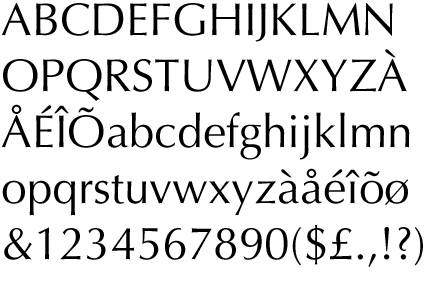
We are almost done. Another reason to not use Times New Roman is because it has terrible kerning. Kerning is the spaces between the letters. If you are going to make a title or a design you need to mess with all the values between the letters. Its a little tedious, but it really needs to be done as computers aren't smart enough to do it. Just look at two letters, if they are too close, move them apart, if they are too far apart, move them closer together- Do that with the whole title, its more important than you might think.
Ok, last thing- context. The most basic rule of thumb is tradition. You would never ever see a street sign with a serif font on it. You would never see a bank name written in a cursive or script font. You would never see warnings or cautions written in serif. Same with labels, cereal boxes, or most consumer packaging. Its all about convention. If you are going to write a more technical thing that is going to be shown on a website, use a sans font. If you are going to write a poem that will be in a book or magazine, use a serif font. Its not always about which has easiest legibility. It is more about what the type face's voice, and the conventions.
 These fonts are: Aenigma Scrawl, PsusdoSaudi, Sketchy, Inkburrow, Adore64, and Tengwar Annatar. Here is something you can all try at home. Write down 3 adjectives for yourself. Find one font for each of those adjectives, then find one font that matches all those adjectives to write your name. Its a lot of fun. Afterward, try to remember which fonts you used, and which adjectives they were really good at. Or since you are reading this now, try to come up with a list of adjectives for all 6 of the above fonts, or pull out your movie collection, and look at the movie title fonts and see why they were chosen.
6.04.2007
The Golden Compass looks amazing

I really need to read this book.
I really need some free time to do it.
5.20.2007
Jumping through the hoop
I am taking some classes this term. Two of them are hoops to jump though. First there is Technical Drafting- not with AutoCAD, this class is by hand. Its very tedious, I probably won't ever use the skills I gain, but I'm kinda glad (3 on a scale from 1 - 10) that I'm leaning how to do it.
Secondly there is Technical Writing, a second English class that everyone has to take. In this class we learn about the proprieties of the English language, especially tailored to nerdy subjects - like computer science, engineering and the like. I discovered during the first period that the only technical writing I'll be doing is writing lesson plans, which are mainly for personal use, and sometimes for a sub, but I've already been instructed on how to write lesson plans in other classes. Mrs. Fieldstead isn't going to be able to teach me better.
I also realized another fact during the first few periods. My job, what I do, is in many ways the opposite of what Mrs Fieldstead does. English makes rules we all have to conform to, and its my job to break those rules and to make exceptions acceptable. Of course its not just my job, lots of other people do it. Thanks to all the technical experts on the world wide web.
If I wanted to research, say- video game usage in the classroom, I could if I really wanted to- look up the information in peer reviewed journals, something that I have to buy a subscription to or get through someone who has one. Or I could go find an 'expert' that has made his or her information accessible to the world through the internet. I wouldn't be able to cite a blog in a technical research paper though, but wait. . . If I was writing a paper for a scholarly journal, I would be contributing to the collaboration happening in those journals, something that could be called a very closed community (relatively). Or I could very easily contribute (what I can) to the collaboration happening online, a very real and extensive collaboration. If I was going to spend 500 calories contributing my two cents to something, which would be better? More accessible? More free? Easier to respond to, and comment? It would not be a journal. They don't contain the wealth of information they used to. The internet is a wealth of information that print could never ever duplicate.
The internet has its own rules about what is valuable and what isn't. The Wikipedia debate is still going on if it is credible enough to be cited in papers as an encyclopedia. They are kind of missing the point. Yes, anyone is allowed to edit the page and write what they want, and for that very reason it is one of the best sources you could ever want. Information isn't being produced by the Cambridge folk (its not all Webster, and Britanica, and high and might committees), its being provided by everyone in the world. What is posted on Wikipedia's pages are continually getting closer to the absolute truth, in the same way a mathematic graph approaches a limit.
My teacher went off on this mega-lecture about how bad the internet is. She had all these horror stories about incorrect information and it ruining peoples lives. Either the whole lecture was BS, or she didn't understand what she was talking about. Probably the latter. There isn't any good concrete reason that English has to be 10 years behind the times. I think the concept of open-source is a good metaphor. People write code that do very valuable things (openOffice, Firefox, Java, etc). By virtue of writing it down and creating something, it gets a copyright. BUT its still out in the open and everyone can use it. Hundreds or thousands of people do this- they make what they make open to the public, it still is copyrighted, but its open-source, you can take it, change it, use it, whatever, freely.
If information is valuable, "good" then its paid attention to, or the right people link to it. There is a very fluid way that "good" things come to the forefront, and "bad" things go down the chute. If you don't have any idea of what I'm talking about- look up: digg, del.icio.us, reddit, stubleupon, newsvine, or find out what the pbwiki is (link2) (link3).
This is what would be valuable from an English class: learning proper grammar and such (so I can stop the literary faux pas of doing something wrong and looking like an idiot), and learning about asking for grants and money (because that is important in education), and thats all, except everyone else might do well having to take an internet literacy course. The right action is to incorporate it, not to pretend its not there or is bad.
Secondly there is Technical Writing, a second English class that everyone has to take. In this class we learn about the proprieties of the English language, especially tailored to nerdy subjects - like computer science, engineering and the like. I discovered during the first period that the only technical writing I'll be doing is writing lesson plans, which are mainly for personal use, and sometimes for a sub, but I've already been instructed on how to write lesson plans in other classes. Mrs. Fieldstead isn't going to be able to teach me better.
I also realized another fact during the first few periods. My job, what I do, is in many ways the opposite of what Mrs Fieldstead does. English makes rules we all have to conform to, and its my job to break those rules and to make exceptions acceptable. Of course its not just my job, lots of other people do it. Thanks to all the technical experts on the world wide web.
If I wanted to research, say- video game usage in the classroom, I could if I really wanted to- look up the information in peer reviewed journals, something that I have to buy a subscription to or get through someone who has one. Or I could go find an 'expert' that has made his or her information accessible to the world through the internet. I wouldn't be able to cite a blog in a technical research paper though, but wait. . . If I was writing a paper for a scholarly journal, I would be contributing to the collaboration happening in those journals, something that could be called a very closed community (relatively). Or I could very easily contribute (what I can) to the collaboration happening online, a very real and extensive collaboration. If I was going to spend 500 calories contributing my two cents to something, which would be better? More accessible? More free? Easier to respond to, and comment? It would not be a journal. They don't contain the wealth of information they used to. The internet is a wealth of information that print could never ever duplicate.
The internet has its own rules about what is valuable and what isn't. The Wikipedia debate is still going on if it is credible enough to be cited in papers as an encyclopedia. They are kind of missing the point. Yes, anyone is allowed to edit the page and write what they want, and for that very reason it is one of the best sources you could ever want. Information isn't being produced by the Cambridge folk (its not all Webster, and Britanica, and high and might committees), its being provided by everyone in the world. What is posted on Wikipedia's pages are continually getting closer to the absolute truth, in the same way a mathematic graph approaches a limit.
My teacher went off on this mega-lecture about how bad the internet is. She had all these horror stories about incorrect information and it ruining peoples lives. Either the whole lecture was BS, or she didn't understand what she was talking about. Probably the latter. There isn't any good concrete reason that English has to be 10 years behind the times. I think the concept of open-source is a good metaphor. People write code that do very valuable things (openOffice, Firefox, Java, etc). By virtue of writing it down and creating something, it gets a copyright. BUT its still out in the open and everyone can use it. Hundreds or thousands of people do this- they make what they make open to the public, it still is copyrighted, but its open-source, you can take it, change it, use it, whatever, freely.
If information is valuable, "good" then its paid attention to, or the right people link to it. There is a very fluid way that "good" things come to the forefront, and "bad" things go down the chute. If you don't have any idea of what I'm talking about- look up: digg, del.icio.us, reddit, stubleupon, newsvine, or find out what the pbwiki is (link2) (link3).
This is what would be valuable from an English class: learning proper grammar and such (so I can stop the literary faux pas of doing something wrong and looking like an idiot), and learning about asking for grants and money (because that is important in education), and thats all, except everyone else might do well having to take an internet literacy course. The right action is to incorporate it, not to pretend its not there or is bad.
5.04.2007
film: Spiderman 3
 Jerman's rating: 4 steps forward, 1 step back. Defcon 3 (Moderate) for battle scenes, deaths, and bad attitudes. Everyone can watch and enjoy this movie, but it deals with love, vengeance, jealousy, friendship, and other strong forces. The people that will like it most will personify with the characters.
I'd like to explain the rating I've given it, but would like to do it in a way that doesn't give away anything from the movie. Those of you who know me well, know that I care very little about spoilers, I usually spoil myself before watching a movie. Well, every rule deserves an exception. This film is good; by good I mean moral, not cool, although it certainly is cool as well. The film isn't just structured by the morality, it kind of puts itself on the line- "I don't care if people are turned away by this, I'm being openly moral anyway."- is what the movie would say if it could talk.
The step back is for very trivial inconsequential things, like expecting rewards and praise for doing service, double standards for males and females, bending/breaking the rules in dire times, a few others. You may notice them, this movie is the perfect case for 1 step back, the immorality is very trivial, it's fantastic.
As I said above, this movie is about some pretty heavy stuff, and while it could bog you down, this film handles it all masterfully. Friends stabbing each other in the back, loyalties changing, forces of love, anger and revenge, and also about having a choice and choosing what's right.
This film could have just gone straight to the threat and then teach the morals, but the plot in this film IS the characters' development. And the morals are that much stronger. The good thing is that several characters are going through developments at the same time, not just Peter Parker; all of them have great things to teach. By the end you just love so many of the charcters, they are really great, or rather become realy great.
I have to include a paragraph about the artistry in this film. The cinematography is astounding, but while other movies use cinematography to paint still shots, this film uses it to paint moving shots, not beautiful as a still shot, but as a clip. It's quite amazing how they do it. The score is the best Spiderman score yet. The production design and costuming adds a lot, as you will see when you watch it for yourself. The special effects and computer animation is still blowing my mind, I have no idea how they did some of the things they shot.

After I watched this film, I had a feeling I've had only after watching certain other films. Only a few films get the "THIS is the reason I watch films." Every time I sit down to watch a movie, I'm secretly hoping it is going to be something specific, or general, but be it nonetheless. Spiderman 3 was that film. I hope that I can watch a Spiderman 3 kind of film every time I watch a new movie. I highly recommend that everyone see this film.
4.30.2007
film: What Dreams May Come
 Jerman's Rating: 4 steps forward, 0 steps back. I'm seeing more and more 0s, which I though didn't exist, if you think I'm wrong, watch the movie and tell me something bad it teaches. Defcon 3 (Moderate) for being really sad, and seeing some im-pleasantries. Lots of people are going to be able to watch this movie, but the people that would appreciate it most, and grasp what its saying are post high school folks, when marriage and love are much more important.
I have to start out saying that I really really loved this film. It excellence is only exceeded by the number of people that aren't going to like it. Its not a conformist Hollywood film, its a little avant-garde, it has a unique style, and its simply beautiful.
Its a love story, now my favorite among them, but it isn't a chick flick. There is a lot of sadness throughout the film, but a special kind of love defeats it all.
Some of the beautiful things in the movie include: Its depiction of heaven "there is room here for everyone to have their own personal universe." The depiction of what makes Hell hell and why people go there.
The casting is done great, everyone's role is perfect. The visuals, the cinematography and the special effects were amazing, all that has to be tied to costuming and production design. It was hard to separate each job, they worked together so well. The story telling deserves credit too, there were tons and tons of flashbacks, it was sort of non-linear and had gaps not and then but this story couldn't have been told better. As far as how well this film was done technically, its among the best I've ever seen. Lord of the Rings was made practically perfect (as far as film making finesse goes), and What Dreams May Come is right up there with it.
This movie references another, this is something I frequently forget to mention, but I like to because it sheds a lot of light on the film we're watching. Hamlet, during his "to be or not to be" monologue, talks about the workings of death. He wonders if its all over when you die, nothing afterward. Then he wonders if death is but a sleep wherein you dream, he likes that better. This is where the title comes from "What dreams may come" in the sleep of death.
 I really would recommend this movie for everyone, whether they would like it or not. The things it teaches about love and family should be understood by everyone. How we live our life here affects our life later on, it doesn't matter what you believe in after death, how we live now affects us later. However, if you are into somewhat artistic films, then I can't encourage you enough to watch this one.
4.29.2007
Re-thinking some things
Sorry, still no movies, I haven't actually watched that many recently. Maybe I'll do Spiderman 3 if I'm able to go and see it this weekend.
I went swimming this weekend and got a really terrible cramp in my calf, that didn't ever go away, so I sat on some chairs and watched all the kids swimming around. I watched this kid really close to me swim laps, he was probably 10, so why he was swimming laps is beyond me, but he was, and he had terrible form, it wasn't a very good crawl, and it wasn't fast either. I watched some kids try and climb up this rope thing that is there. Some of them could do it, some of them couldn't. They were doing it really inefficiently too. If their goal was to get to the top (which I'm assuming it was) they could change their technique a little bit and they would do much better. I watched a few other people and noticed that they could do a lot more if they changed how they were doing what they were doing.
All of this caused me to think about a lot of things.
I've taken one swimming class in my entire life, so I by no means know very much, but a professional did teach us and showed us correct form, and I know from personal experience that its a lot better. That kid in the lane closest to me, the one with terrible form, would he have liked to know a better way to do it? Would he have cared? If he has his own way of doing things, then who am I to show him my way of doing things? Whats to say that my way is better than his way?
I had the same questions for the kids trying to climb the rope thing. Sometimes I feel like I'm teaching Jerman principles and not teaching the absolute and universally correct principles. That sentence came out weird. I feel sometimes like I'm putting too much of myself in what I teach to other people. There isn't any reason why my ways are better than anybody else's ways.
I'm also on my way of being a teacher. The kids in my classes are all going to already have ideas about how the world works, but there is a lot of things they just don't know, and don't know they don't know it. Like climbing the rope, they don't know how to do it, and I'm going to both tell them about the rope, and how to climb it.
Then there are still those people that know about the rope, have their own way of climbing it, and are doing a bad job of it. Would the world be a better place if all the robe climbers did it well? I think that's the wrong question to be asking.
I went swimming this weekend and got a really terrible cramp in my calf, that didn't ever go away, so I sat on some chairs and watched all the kids swimming around. I watched this kid really close to me swim laps, he was probably 10, so why he was swimming laps is beyond me, but he was, and he had terrible form, it wasn't a very good crawl, and it wasn't fast either. I watched some kids try and climb up this rope thing that is there. Some of them could do it, some of them couldn't. They were doing it really inefficiently too. If their goal was to get to the top (which I'm assuming it was) they could change their technique a little bit and they would do much better. I watched a few other people and noticed that they could do a lot more if they changed how they were doing what they were doing.
All of this caused me to think about a lot of things.
I've taken one swimming class in my entire life, so I by no means know very much, but a professional did teach us and showed us correct form, and I know from personal experience that its a lot better. That kid in the lane closest to me, the one with terrible form, would he have liked to know a better way to do it? Would he have cared? If he has his own way of doing things, then who am I to show him my way of doing things? Whats to say that my way is better than his way?
I had the same questions for the kids trying to climb the rope thing. Sometimes I feel like I'm teaching Jerman principles and not teaching the absolute and universally correct principles. That sentence came out weird. I feel sometimes like I'm putting too much of myself in what I teach to other people. There isn't any reason why my ways are better than anybody else's ways.
I'm also on my way of being a teacher. The kids in my classes are all going to already have ideas about how the world works, but there is a lot of things they just don't know, and don't know they don't know it. Like climbing the rope, they don't know how to do it, and I'm going to both tell them about the rope, and how to climb it.
Then there are still those people that know about the rope, have their own way of climbing it, and are doing a bad job of it. Would the world be a better place if all the robe climbers did it well? I think that's the wrong question to be asking.
4.22.2007
Semester recap
Nothing made me feel quite so honored as when Liz Rhodes asked me to the Utah Symphony with her.
Nothing made me feel quite so loved as when members of my major heart attacked my door with get-well hearts on Valentines day.
Nothing made me feel quite so relieved as a discussion one Friday afternoon.
I've never been so tired as after a week of editing all-nighters.
I've never felt quite so unjustified as the experience with my towed car.
I've never felt so high as when things started to turn around.
I've never felt quite so dead as when I was sick.
I've never felt quite so alive.
Nothing made me feel quite so loved as when members of my major heart attacked my door with get-well hearts on Valentines day.
Nothing made me feel quite so relieved as a discussion one Friday afternoon.
I've never been so tired as after a week of editing all-nighters.
I've never felt quite so unjustified as the experience with my towed car.
I've never felt so high as when things started to turn around.
I've never felt quite so dead as when I was sick.
I've never felt quite so alive.
4.20.2007
I'm sorry, I know I haven't made a real post in a long long time. but life is kind of crazy right now with filming, finals, and everything else. In that order. As soon as finals are over, I'll make a point to watch a movie and rate it for you. I have one request right now, I'll get it done as soon as I can.
4.12.2007
New Toy, or rather toyS
It took almost the entire semester, but I finally caved into getting The Adobe Creative Suite 2.
It comes with Photoshop, Illustrator, InDesign, GoLive, ImageReady, Acrobat, and a bunch of other peripheral Adobe programs, Dreamweaver also came in the package.
It gets better.
Within a month or two it upgrades free to CS3 of everything, includes Photoshop extended, and it also comes with Flash. I got it through the BYU Bookstore, it was very inexpensive, saving me thousands and thousands of dollars. I don't need to say it, but I'll say it anyway. I'm excited about having my new toys.
It comes with Photoshop, Illustrator, InDesign, GoLive, ImageReady, Acrobat, and a bunch of other peripheral Adobe programs, Dreamweaver also came in the package.
It gets better.
Within a month or two it upgrades free to CS3 of everything, includes Photoshop extended, and it also comes with Flash. I got it through the BYU Bookstore, it was very inexpensive, saving me thousands and thousands of dollars. I don't need to say it, but I'll say it anyway. I'm excited about having my new toys.
4.07.2007
4.04.2007
2 hours of your time?
In one of my teaching classes we are learning about assessment and creating rubrics. I asked my professor for some help in perfecting the rubric that I use to rate movies for this site. He understood everything with only looking at it for a minute or two and saw how it could be used, this is a good sign. We talked about the rubric for a few minutes, I explained how I want it less dependent on me, more mathematical, and less subjective. Each film is getting graded a few times: good teachings, bad teachings, content, and age level.
The way I rate movies is by writing down a list of all the good and bad things it teaches, or make a list of cool people and what they do and disliked characters and what they do. Then I look at that list the same time as the rubric and then give it the rating.
My professor then told me that I need to have some other people use my rubric to see how robust it is. If many people watch a movie and give the same rating then the rubric is a good one, if not, then I have some things to change or clarify.
I need some volunteers. I need a few people that can use my system and rate the same movie and then we all compare notes. Come find me or email me and we'll choose a film and a time once we get enough people.
On a side note: I'm also collecting movie quotes, If you'd like to help then write down the good quotes from the next movie you watch (exact wording is sorta important) and email them to me, this is going to be a big post (a reader participation post), which is going to get updated a whole stinking lot.
The way I rate movies is by writing down a list of all the good and bad things it teaches, or make a list of cool people and what they do and disliked characters and what they do. Then I look at that list the same time as the rubric and then give it the rating.
My professor then told me that I need to have some other people use my rubric to see how robust it is. If many people watch a movie and give the same rating then the rubric is a good one, if not, then I have some things to change or clarify.
I need some volunteers. I need a few people that can use my system and rate the same movie and then we all compare notes. Come find me or email me and we'll choose a film and a time once we get enough people.
On a side note: I'm also collecting movie quotes, If you'd like to help then write down the good quotes from the next movie you watch (exact wording is sorta important) and email them to me, this is going to be a big post (a reader participation post), which is going to get updated a whole stinking lot.
3.28.2007
film: Persuit of Happyness
 Jerman's Rating: 4 steps forward, 1 step back. Defcon 3 for the tough situations the main character is in and the desperate plight in the plot. This film is for 18+, basically anyone out of high school and about to start a family or career.
This film was really hard for me to rate, the main character is definitely in the poverty level. The line between survival and morality becomes less and less clear, making rating this one very hard.
One of the biggest morals and contributors to the rating is how family was handled. Christopher (the son) is the most important thing in Chirs's life (the dad). Being able to care for his son gives him the greatest happiness. The mother (unlikable character, but highly relate-able) eventually leaves the family but not before confronting her choices and making the decision based on what is best for her son.
The main character, Chris, does many things we would consider immoral, like avoiding rent (Spiderman does it too), not paying rent at all, tax evasion, and illegal parking. He gets a fair consequence for all of his actions, but these actions should be weighed. If younger kids watch this movie, they might not understand the situation the family is in and might think that living in an apartment without paying for it is ok. I'll have to disclaimer myself here saying that I'm also not saying that if you're poor you have more liberty to steal and break the law, thats incorrect and shouldn't be encouraged. Several people through the movie are very kind to Chris's family and show him mercy (up to a point) I think this point is more important to stress, and I liked the way it was handled.
I also enjoyed that a church scene was included. Complete with a gospel choir and an audience clapping and crying. Chris is shown picking up his son, hugging him and having a spiritual moment. I don't know how religious the real man was (this was based on a true story), or how religious he was implied to be, I'm just happy this scene was in the movie.
This movie if it had to be classified, I would put in with the "inspirational movies." With that said, this movie is pretty depressing and very rough. If you can't stand watching movies like Meet the Parents because of all the awful things that happen one after another, the same thing might bug you here. Poverty and poor people are confronted a lot, this might make you uncomfortable, but raises some good questions for you to answer for yourself.
 A moral film with good messages, its very professionally done, its kept at a slower pace, and doesn't start being positive until the near-end. Like I said before- If you are in a transition period in your life- starting a career or starting a family- then I'd more recommend this movie for you; as you would be able to relate a lot more.
3.14.2007
You know that
..we have moved to a different century when instead of asking: "If a tree falls in a forest and no one is around to hear it-- Did it really happen?"
Its better to ask: "If a tree falls in a forest and none of the witnesses blog about it-- Did it really happen?"
Its better to ask: "If a tree falls in a forest and none of the witnesses blog about it-- Did it really happen?"
What the Anime?
I talked about making this post back during the Mononoke review. I've been a little slow getting this up because I feel a little inadequate for the job. Before you finish the post, (if you are going to read it that is) know that I'm just an amateur film lover, and everything I write here is just my observations.
Anime or Japanamation is one of the most disliked mediums for an average American. There are a lot of things associated with Anime that make it very foreign. It doesn't buy into Hollywood very much, thats for sure. I could draw an analogy to director John Woo, who is also disliked. He has a very visual style with similar themes (birds) in many of his visuals. Because the average movie-goer is expecting one thing and gets John Woo instead- John Woo gets hated on. He is actually pretty good if you go in knowing what you're going to get. Anime can be like that. Here are 9 pictures of different animations. Click on them to make them bigger. Some of them are Anime, some of them are American. All of them are a little weird in their own right.
 The quintessential cartoon that everyone goes to first to make fun of Anime (this is Pokemon if you didn't know). However its not popular without reason. Any trait you find common in anime you can find here- the proportional bodies, the extreme polar emotions, the blue hair, the mouth and eye sizes . . . As far as anime goes, this is one of the lowest quality.
 I have no idea where this is from. The characters emotions is one of the defining traits. Instead of actions and reactions being emphasized (like in Disney or WB) the emotions are. Primarily happy and mad. Depression is pretty popular, as is shock. Emotions are relied on more heavily to tell the story, and develop the characters. Gimmicks like the squinty eyes, tear waterfalls are used by the low quality anime to quickly fill you in. The more serious anime has to do other things- but still relies on emotions.
 You really gotta take a bigger look at this picture. Disney (I think) made this cartoon. There's a couple things you need to notice. Human proportions are thrown out the window. Everyone is drawn to make the visual impact and define the character's personality. You know who the jerk is, who the main character is, who the snobby one is etc. Now, look at the dukes mouth- this is the same size or bigger (propotionally) as any wide mouth in anime- the difference is that the mouth stays that big all the time, same with the eyes. Nobodies face or body is constructed like that- but this is what we are used to and call "cartoons"; Anime doesn't keep these rules, they live by different rules and are unfamiliar.
 Ah, Batman and Robin. This is a step up from Gummi Bears. There is more thematics and morals, people are drawn more real (still incorrect proportions), color and shading are better, and the movement of characters is better.
 This is from a TV show called Gundam Wing (one of the 7). Its higher quality than Pokemon, equatable with Batman and Robin. This one is steeped with rhetoric, mostly about the morality of war. Human proportions are maintained, but a little exaggerated for some people. You can tell by this picture that the face is much more solid than Disney cartoons, the eyes and ears are at the right spot for the most part. There's giant robots in this one that fly around in space in cool poses. There are cool battles, good bad guys, bad good guys, fuzzy lines and motivations- all of which define the medium.
 Hmm, this looks anime, but is American... which is it? Its American, its just drawn really poorly, which creates its (very) unique style (and makes it annoying). The story is told with actions and reactions, not emotions, and plays off American ideals, there's no way it could be anime.
 This is a frame from Princess Mononoke- one of the higher quality of Anime. Its so high, I would be careful calling it Anime. The humans are drawn to perfect proportion and move as a human would move, the actions are hardly exaggerated. This would be equatable to Sleeping Beauty -only more adultish- there are painted backgrounds with very good animations.
 And we return again to the animation juggernaut. If you look at the image- Aladdin and Jasmine aren't drawn the way a human looks, the eyes are still to big, the head is too big, and they don't quite move correctly either, we accept this because this is our definition of what a cartoon is supposed to look like. There is one thing that everyone might not have noticed. Cartoon characters never change clothes. If Aladdin changed his clothes he would appear at first like a different character until he started speaking. Cartoon characters kind of have to keep their same costume for the audiences sake of identifying them. In anime, the characters change clothes quite often, but they never get a hair cut. The crazy hair is used to identify the character, thats why its a little crazy, and often looks the same from many different angels.
 I don't have anything left to say. You come up with something, and write it here.
If any of my readers are more knowledgeable about these things than I, and I'm sure many of you are, I'd really really love it if you shot me a message telling me if I've got something wrong or whatever. To the rest of you- Just because DragonBallZ and Pokemon are so easy to disregard and make fun of, don't shut the door, I've found that most people who say they don't like any anime, actually like a lot of it.
Anime or Japanamation is one of the most disliked mediums for an average American. There are a lot of things associated with Anime that make it very foreign. It doesn't buy into Hollywood very much, thats for sure. I could draw an analogy to director John Woo, who is also disliked. He has a very visual style with similar themes (birds) in many of his visuals. Because the average movie-goer is expecting one thing and gets John Woo instead- John Woo gets hated on. He is actually pretty good if you go in knowing what you're going to get. Anime can be like that. Here are 9 pictures of different animations. Click on them to make them bigger. Some of them are Anime, some of them are American. All of them are a little weird in their own right.
 The quintessential cartoon that everyone goes to first to make fun of Anime (this is Pokemon if you didn't know). However its not popular without reason. Any trait you find common in anime you can find here- the proportional bodies, the extreme polar emotions, the blue hair, the mouth and eye sizes . . . As far as anime goes, this is one of the lowest quality.
 I have no idea where this is from. The characters emotions is one of the defining traits. Instead of actions and reactions being emphasized (like in Disney or WB) the emotions are. Primarily happy and mad. Depression is pretty popular, as is shock. Emotions are relied on more heavily to tell the story, and develop the characters. Gimmicks like the squinty eyes, tear waterfalls are used by the low quality anime to quickly fill you in. The more serious anime has to do other things- but still relies on emotions.
 You really gotta take a bigger look at this picture. Disney (I think) made this cartoon. There's a couple things you need to notice. Human proportions are thrown out the window. Everyone is drawn to make the visual impact and define the character's personality. You know who the jerk is, who the main character is, who the snobby one is etc. Now, look at the dukes mouth- this is the same size or bigger (propotionally) as any wide mouth in anime- the difference is that the mouth stays that big all the time, same with the eyes. Nobodies face or body is constructed like that- but this is what we are used to and call "cartoons"; Anime doesn't keep these rules, they live by different rules and are unfamiliar.
 Ah, Batman and Robin. This is a step up from Gummi Bears. There is more thematics and morals, people are drawn more real (still incorrect proportions), color and shading are better, and the movement of characters is better.
 This is from a TV show called Gundam Wing (one of the 7). Its higher quality than Pokemon, equatable with Batman and Robin. This one is steeped with rhetoric, mostly about the morality of war. Human proportions are maintained, but a little exaggerated for some people. You can tell by this picture that the face is much more solid than Disney cartoons, the eyes and ears are at the right spot for the most part. There's giant robots in this one that fly around in space in cool poses. There are cool battles, good bad guys, bad good guys, fuzzy lines and motivations- all of which define the medium.
 Hmm, this looks anime, but is American... which is it? Its American, its just drawn really poorly, which creates its (very) unique style (and makes it annoying). The story is told with actions and reactions, not emotions, and plays off American ideals, there's no way it could be anime.
 This is a frame from Princess Mononoke- one of the higher quality of Anime. Its so high, I would be careful calling it Anime. The humans are drawn to perfect proportion and move as a human would move, the actions are hardly exaggerated. This would be equatable to Sleeping Beauty -only more adultish- there are painted backgrounds with very good animations.
 And we return again to the animation juggernaut. If you look at the image- Aladdin and Jasmine aren't drawn the way a human looks, the eyes are still to big, the head is too big, and they don't quite move correctly either, we accept this because this is our definition of what a cartoon is supposed to look like. There is one thing that everyone might not have noticed. Cartoon characters never change clothes. If Aladdin changed his clothes he would appear at first like a different character until he started speaking. Cartoon characters kind of have to keep their same costume for the audiences sake of identifying them. In anime, the characters change clothes quite often, but they never get a hair cut. The crazy hair is used to identify the character, thats why its a little crazy, and often looks the same from many different angels.
 I don't have anything left to say. You come up with something, and write it here.
If any of my readers are more knowledgeable about these things than I, and I'm sure many of you are, I'd really really love it if you shot me a message telling me if I've got something wrong or whatever. To the rest of you- Just because DragonBallZ and Pokemon are so easy to disregard and make fun of, don't shut the door, I've found that most people who say they don't like any anime, actually like a lot of it.
3.10.2007
film: 300
 Jerman's rating: 3 steps forward, 2 steps back. Defcon 5. Movie for adults only (21 adults not the 18 type).
There is quite a bit of disturbing and questionable content. The violence is very graphic, but done in a cartoonish way. There is a lot of stabbing and beheading. There is a lot of breast shots too, and not just the quick shot, they get ample screen time, if that bothers you and you still want to watch the movie there are two scenes where you need to cover your eyes. Personally I didn't care for the sex scene one bit, it didn't leave much to the imagination- either what they were doing, or how they were doing it. Despite the content the film is surprisingly moral and teaches great things, and is almost devoid of bad messages.
Good messages include: Being honorable (virtuous) at all times in all circumstances, fighting for what is right- whether or not you can win, fighting for the children's future is what's important. Several references are made to submitting or bowing down to a figure. Xerxes can be a symbol of a lot of different things: tyranny, money, glory, power, many things in our society. This kneeling down is strongly discouraged and mocked (This is one of the greatest lines of the movie- "You...May you live forever"). Expressing to those you love that you love them- is briefly discussed. And one more I'll mention is how the hero stands against incorrect traditions and established practices of the society, he is guided by law and also by his own inner morals.
The few bad messages I could come up with include: excessive brutality and violence, and over glorification of the ruthless warrior soldier.
One of my favorite scenes shows just consequences and its great. The wife who offers her body is stung with regret at her compromised immorality and it has consequences. The jerk politician also gets returned to him what he dealt to others.
I have to talk for a minute about the camera work and color usage, which really set this film apart. The colors were, as a friend pointed out, "spartan." Usually the screen was monochromatic (tell me if I'm using this word incorrectly) going from white to black with either a cool blueish color in between (for gray) or a goldish color. There are a few rare times when there are three colors on the screen- its rare though. A lot of the camera work looked computer generated, but was variable speed emphasizing the battle and the Spartan's skill in combat. If you watch the movie you will enjoy the camera work and variable speed, it keeps you in the movie, and is an innovative technique which I could see being employed in future films as well.
 Lastly, I have to tell you about the movie as a whole. Its a He-Man movie. The first half has both coming of age and sexuality. The second half has lots of buff guys, fighting against impossible odds, and saying really cool lines while talking to other groups. Its really just filled with lots of manly masculine things. The girl sitting next to me, who came with a date, didn't seem to like it much, but it seemed almost all the guys loved it. It is heavy on the violence, it does have sexuality (this is either good or bad for you), but it carries very good messages that are very applicable to here and now.
3.08.2007
film: Princess Mononoke
 Jerman's Rating: 3 steps forward, 0 steps back. (Yes, thats a 0, and very rare). Defcon 3 (Moderate). Early adolescence and up.
 This is a first for me, I didn't know they existed, but I've been siting here thinking of everything I can, and I still can't think of anything bad this film encourages or endorses. The main character, Ashitaka, is quite the moral upstanding young man. The lack of tainted messages, and the strong moral values is part of what draws me to Japanese and Chinese cinema. While I'm on that subject, let me tell you a little bit about Japanese animation, also known as Anime, and Japanamation.
I wanted to write this review, really for one reason. I had something in my mind that this movie shows better than anything else I've seen, I also see myself in the same situation. Beware, I'm not afraid of using spoilers. The story goes kind of like this. A young man, a prince, is sent off to the west from the far east. He meets several groups, but remains neutral. While being a good, moral person he helps people and meets more important people. He both understands them and what they are doing, sees the good in them and their causes, and becomes loyal to that group. The catch is that two of these groups are enemies of the worst nature, and in no way can be reconciled. For the rest of the movie Ashitaka helps both groups in his own way while not betraying either one, and tries and fails to reconcile them. Both groups were in the wrong, both were doing good. It would be pointless to assign blame after everything thats been done. In the end both groups learned their lessons and had their great losses.
I'm kind of in the same boat as Ashitaka. It is hard for me to understand why some groups are so filled with hate for each other, while I can identify with both groups. One moment I can sort of understand why they can't get along, in the next I'm yelling "Stop it! You morons!" In case you, dear reader, ever find yourself faced with two groups like this then I would suggest you watch this film. It is especially frustrating when the two groups have the same goals.
Hmm..this film still deserves for me to say a lot more about it; I'll try to keep it short. This film is unconventional by American standards. It's amazing too, because of its unconventionality, or despite it, I'm not sure. Its about Gods and Demons and men. This film also shows the law of harvest, all the characters get rewarded or punished as a result of their actions. There isn't really a bad guy in the film. Lady Eboshi could be mistaken for one, but with her building her city, giving jobs to the brothel girls from the cities and taking them in, as well as taking in the lepers and letting them contribute to the city. With her running the city so well and being moral in her own respect, there is really no way she could be the bad guy.
One way that this animation is different from American animations is that the characters are drawn much much closer to correct human proportions, also the way they move is more realistic and shows wonderful examples of what good animation looks like. The painted scenes are also amazing and beautiful.
The music is also good, I don't mean good in a technical sense as I said about the animation, because I have no clue about the technicality of music composition. But I love the music, sometimes its epic, sometimes its romantic, its a good soundtrack.
There is still a ton that I have left to say. I may possibly edit this post in the future.
 Just from my own personal taste, this movie is among the best, 10 of 10, or 5 of 5, whatever your scale is, this is a great movie. As long as you are old enough to understand it (this isn't a kids movie if you haven't caught yet) I highly recommend it. You don't even have to read subtitles, its dubbed. But- you know your own tastes and you might not like it, still you should give Miyazaki a try.
Subscribe to:
Posts (Atom)